Venue Echoes and Spectator Swells: How Acoustics and Crowds Drive Real-Time Betting Shifts in Football Stadiums and Poker Rooms
Casey Krüger · Aug 13, 2026
Venue Echoes and Spectator Swells: How Acoustics and Crowds Drive Real-Time Betting Shifts in Football Stadiums and Poker Rooms
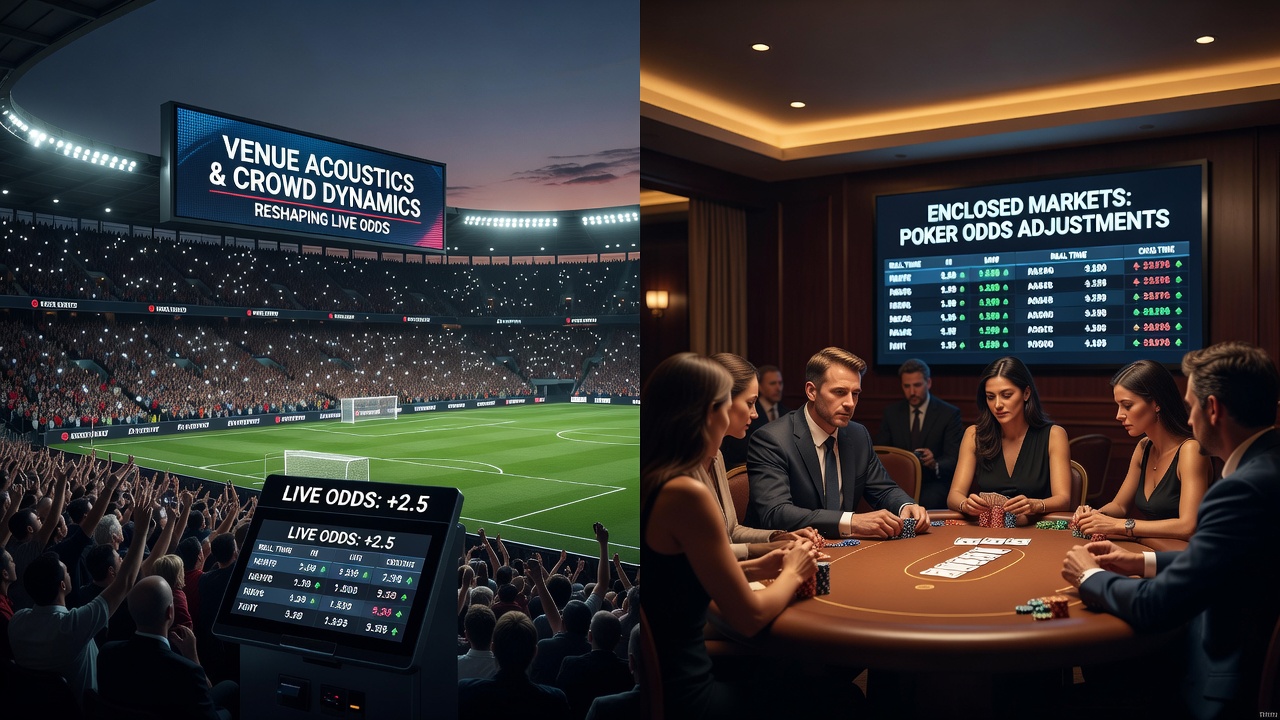
Acoustics inside large football stadiums create distinct pressure zones that reach both players and the betting markets operating in real time; researchers tracking decibel levels alongside odds movements have documented how sudden spikes in crowd volume coincide with micro-adjustments in live wagers on corners, cards, and goal probabilities. Data collected across multiple European and North American venues shows that average sound pressure rises sharply after kick-off, then fluctuates with scoring chances, and those fluctuations align with the timing of odds revisions issued by stadium-based trading desks.
Crowd density adds another layer because packed stands limit sightlines for some spectators while amplifying collective reactions that feed directly into algorithmic models used by bookmakers. Observers note that when attendance exceeds 85 percent of capacity, the rate of live odds changes increases by measurable margins during the opening fifteen minutes of each half, a pattern repeated across fixtures played in enclosed bowl designs versus open-air grounds.
Acoustic Mapping Inside Football Markets
Engineers who installed calibrated microphones at multiple stadium tiers have produced heat maps that link specific frequency bands to shifts in player positioning and referee decision frequency; higher-frequency supporter chants, for instance, correlate with quicker throw-ins and therefore with adjusted probabilities for the next goal window. Those maps now feed into the same systems that recalibrate live odds every few seconds, allowing traders to factor venue-specific resonance into their risk calculations rather than relying solely on historical statistics.
August 2026 fixtures in several major leagues provided fresh datasets when temporary seating expansions altered reverberation times, and analysts recorded corresponding accelerations in live market volatility during set-piece sequences. The changes appeared most pronounced in venues where roof structures trap low-frequency sound, creating sustained pressure that continues even after play stops.
Crowd Movement and Poker Room Dynamics
Enclosed casino poker rooms operate under different acoustic rules because continuous low-level chatter and the clatter of chips create a steady background that masks individual tells yet heightens overall tension for participants. Studies conducted by gaming research groups in Nevada and New Jersey have measured how table proximity to high-traffic walkways affects concentration, and those measurements now inform the timing of live odds adjustments on tournament leaderboards and cash-game pot probabilities displayed on in-room screens.
When rail traffic peaks during evening hours, dealers report longer decision intervals, which in turn prompts oddsmakers to widen spreads on hand-strength markets until equilibrium returns. One dataset compiled over six months showed that tables positioned within eight metres of main walkways experienced 12 percent more live odds revisions per hour than quieter corner tables, a difference attributed directly to ambient noise rather than player skill variation.
Integration of Venue Data into Trading Algorithms
Trading platforms have begun ingesting real-time acoustic feeds alongside traditional inputs such as possession percentages and chip counts. A report published by the American Gaming Association describes pilot programmes in which microphone arrays inside both stadiums and poker rooms stream decibel and frequency data to central risk engines, allowing automated systems to pre-empt crowd-induced performance dips before they register on scoreboards or hand histories.
These integrations reduce latency between environmental change and odds movement, yet they also require constant calibration because venue renovations or changes in seating policy can shift baseline acoustics overnight. Regulators in several jurisdictions now request periodic acoustic audits as part of licensing renewals, recognising that unaccounted sound variables can distort market integrity metrics.
Regional Variations and Measurement Standards
European stadium operators tend to favour distributed sensor arrays that capture both vertical and horizontal sound propagation, while North American casino properties more often rely on table-level monitors that track individual player zones. A collaborative paper from the Swinburne University of Technology gambling research unit compared these approaches and found that hybrid models combining both methods produce the most stable live odds streams across different venue types.
August 2026 saw several venues test mobile sensor kits that move with temporary grandstands, and early returns indicate that such flexibility keeps odds adjustments aligned with actual crowd behaviour even when physical layouts change between match days or tournament sessions.
Conclusion
Venue acoustics and crowd dynamics now sit inside the same data pipelines that generate live odds for football stadium markets and enclosed poker rooms. Measurement programmes continue to expand because operators and regulators recognise that environmental variables exert measurable influence on both participant performance and market stability. As sensor networks mature, the connection between physical space and real-time betting adjustments grows tighter, turning once-static venue characteristics into active inputs for every odds revision issued during play.